
2024 Tanaka Awards
1. Gyaing Kawkareik Bridge
- Department of Bridge, Ministry of Construction, Republic of the Union of Myanmar
- Joint Venture of Central Consultant INC.
- Eight-Japan Engineering Consultants Inc.
- Japan Bridge & Structure Institute INC.
- Katahira & Engineers International
- T.O.P Engineering Consultants International Co., LTD.
- HAZAMA ANDO CORPORATION & PS Construction JV
Contributors of this project (Japanese)
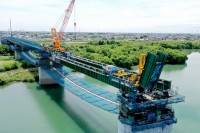
Gyaing Kawkareik Bridge is a seven-span bridge consisting of a main bridge section across Gyaing river (a continuous three-span prestressed concrete bridge) and two approach bridge sections located at both bridge end (continuous two-span steel plate girder bridges). The main bridge section is designed as an extradosed bridge with a maximum span of 180 m length and 22.69m slab width for four track lanes (inbound and outbound). Concrete struts are arranged for supporting overhang slab to accommodate the wide floor slab, and prestressed concrete struts are arranged for diagonal support which distributes the vertical shear force from stay cables from the middle web to the outer webs. The corrugated steel webs are applied to reduce the main girder weight so as to achieve the 180m long span. Triple corrosion protections are adopted into stay-cable system, and weathering steel plates are used for corrugated steel webs of the main bridge and the plate girders of the approach bridges to improve maintainability and durability. This bridge has been praised as a global contribution by using various Japanese bridge technology.
2. Izushima Bridge
Contributors of this project (Japanese)
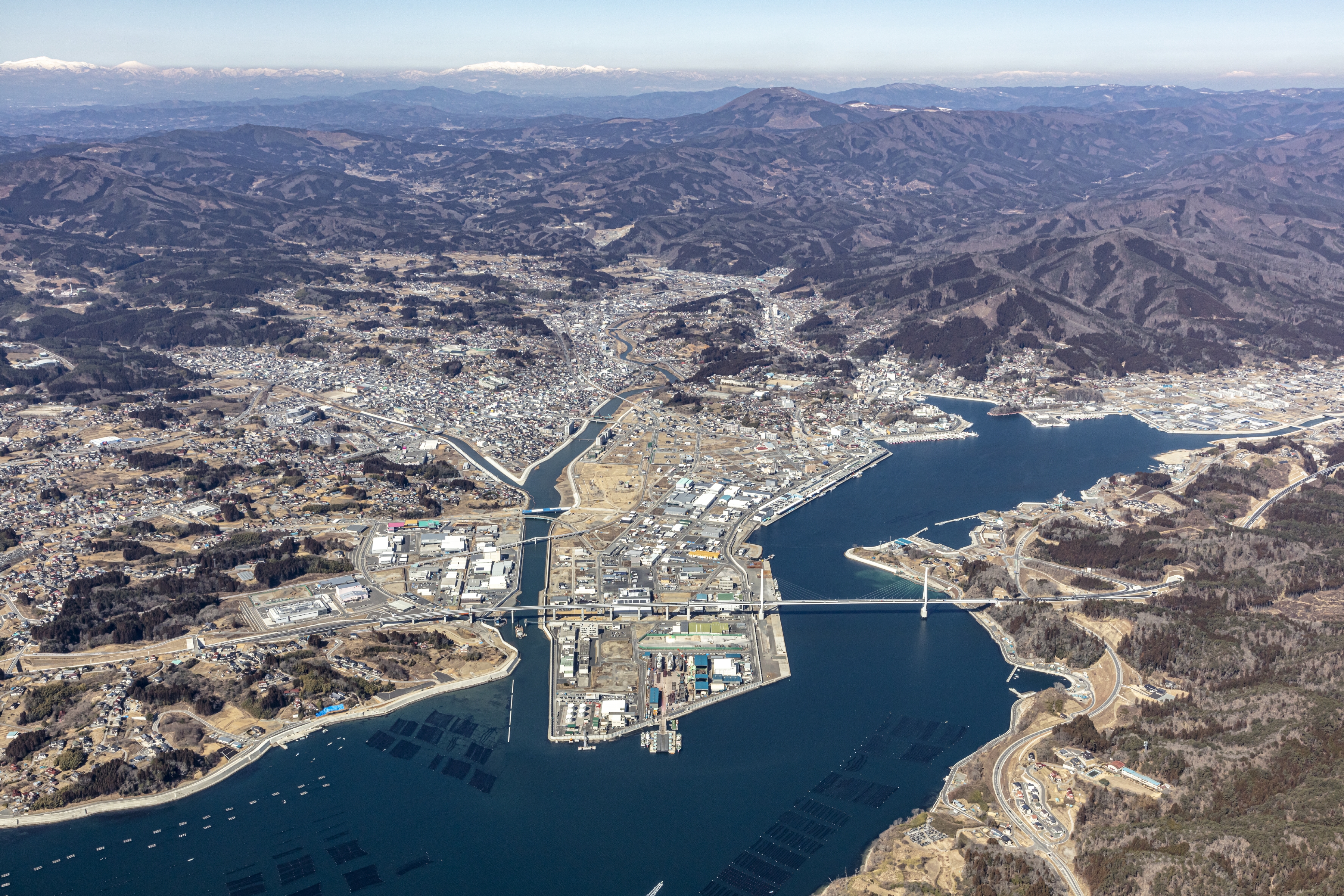
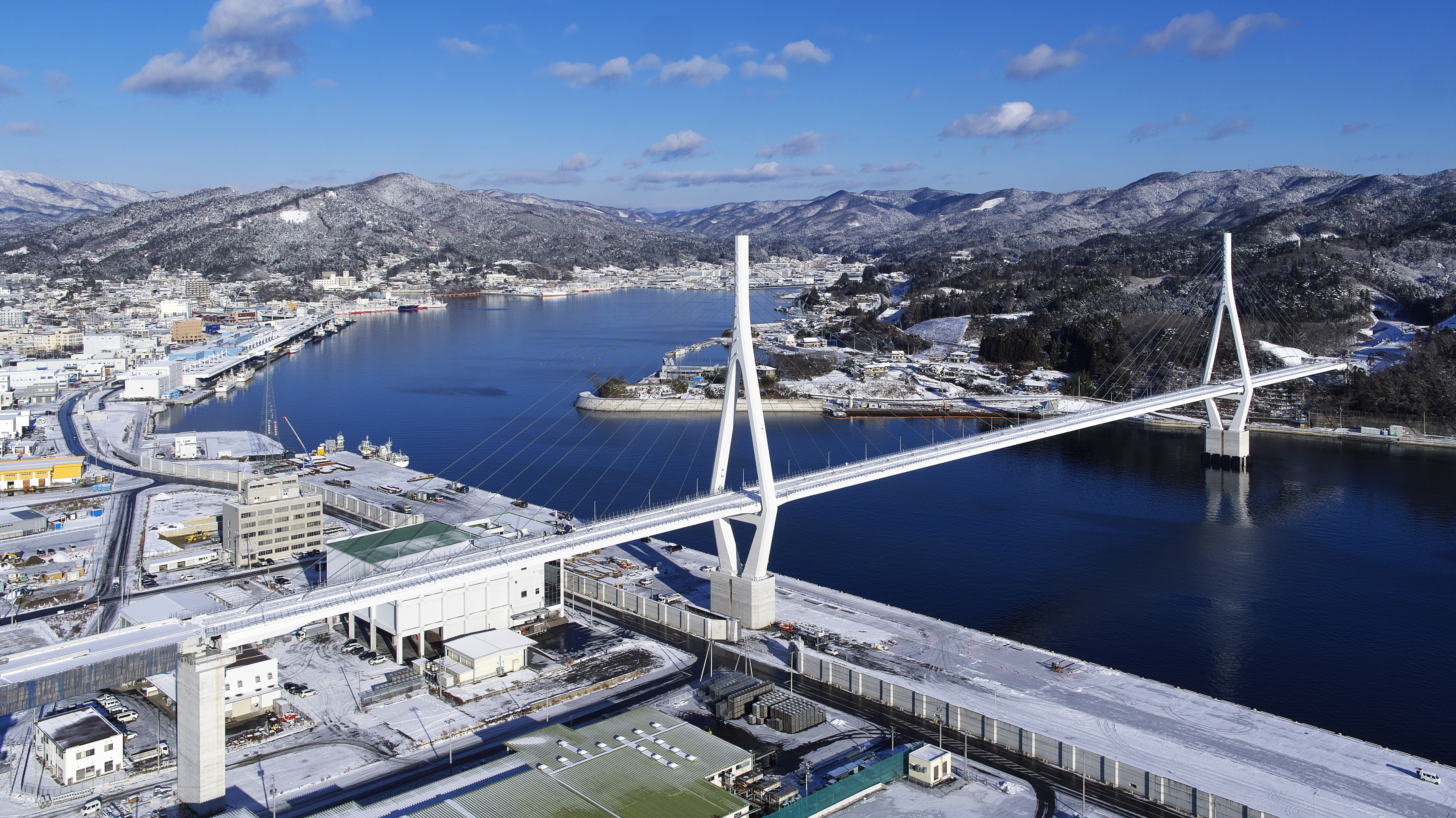
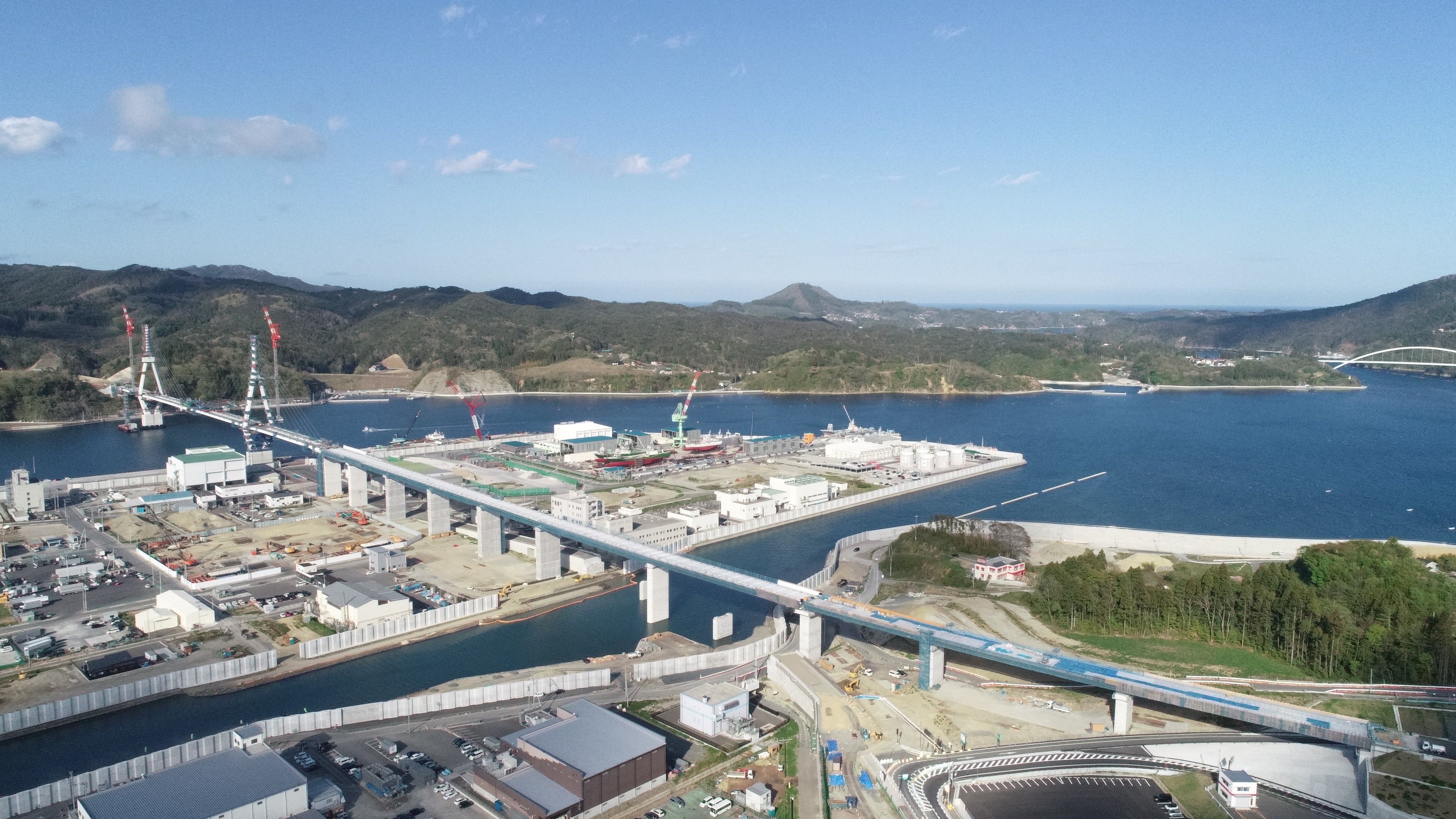
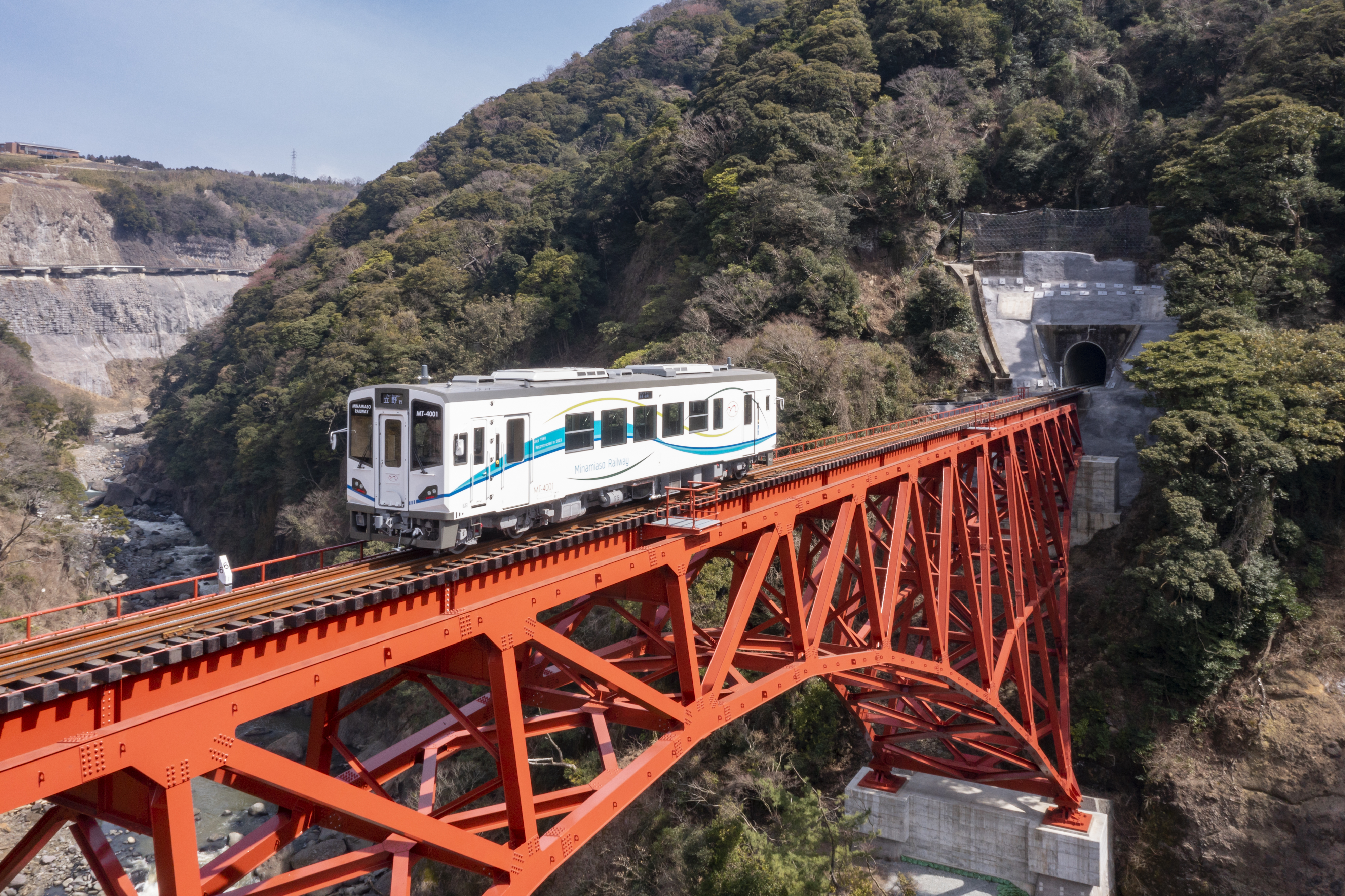
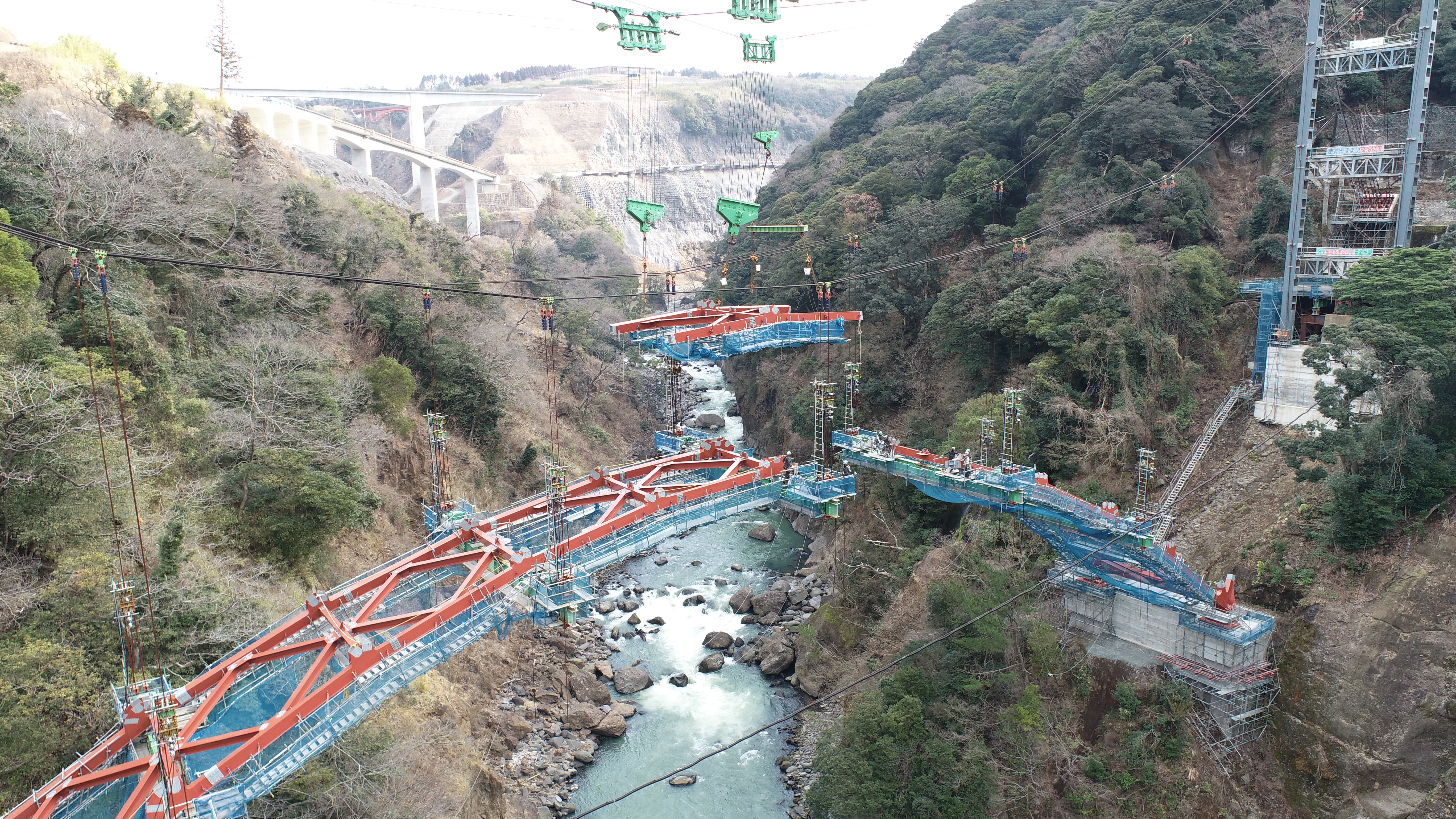
Izushima Bridge is a steel half through arch bridge with a bridge length of 364 meters, connecting Izushima, a remote island in Onagawa Town, Miyagi Prefecture, to the mainland. The necessity of this bridge was reaffirmed following the Great East Japan Earthquake, which caused prolonged isolation for the island's residents. Consequently, the project was officially launched in 2015. The design-build was adopted to achieve both quality improvement and cost reduction, while also incorporating considerations for enhanced durability and maintenance efficiency. Furthermore, after constructing the side spans using temporary supports at sea, the segments of main span, weighing approximately 2,800 tons, was installed as a large block using the floating crane. This bridge has been highly regarded for achieving high-quality bridge construction rooted in the local community.
- Onagawa Town
- Miyagi Prefecture Civil Engineering Department Road Section
- Miyagi Prefecture Eastern Civil Engineering Office
- JFE Engineering Co.,Ltd.
- Dia Nippon Engineering Consultants Co.,Ltd.
- Hashimototen.Co.,Ltd.
- Higashi Nihon Concrete Co.,Ltd.
3. Futami Bridge (Phase II Line)


- West Nippon Expressway Co., Ltd.
- Eight-Japan Engineering Consultants Inc.
- Joint venture of Kajima Corporation and Fuji P.S Corporation Co.,Ltd.
Contributors of this project (Japanese)
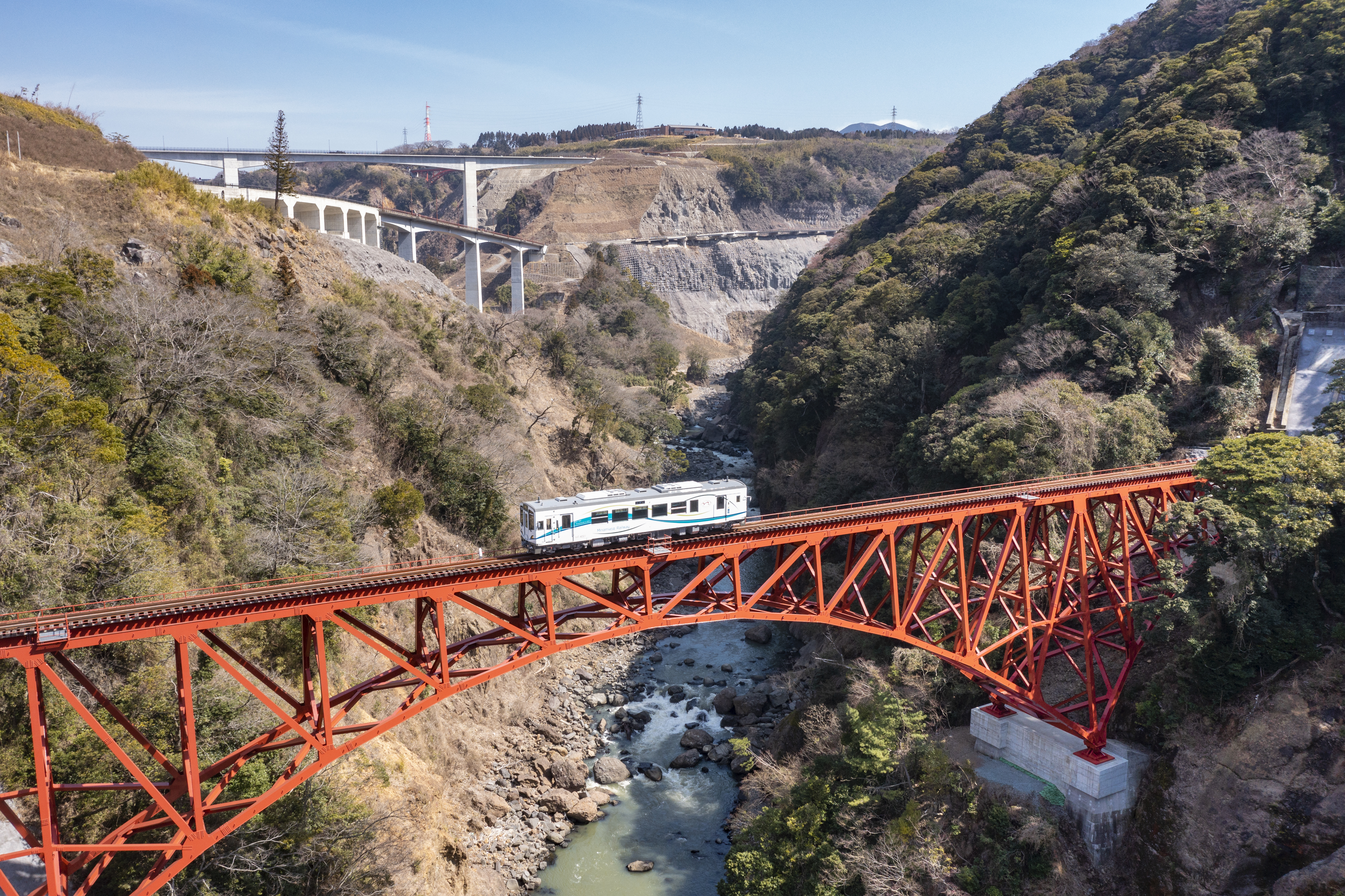
Futami Bridge (Phase II Line) is a 232.3m-long prestressed concrete and 4-span continuous balanced-arch bridge over a steep valley. This bridge is of the inverted Langer type.
The basic form of this bridge was a curved arch bridge of the upper roadway type, due to the consideration of the landscape and the surrounding environment. The arch ribs were constructed efficiently and safely by developing a special arch rib traveling crane.
The construction of the vertical members in the truss overhang erection method was shortened by adopting the method of forming a truss with steel frames and proceeding with the overhang construction, followed by the concrete wrapping (SRC structure).
4. The Renewal Project of the Tomei Tamagawa Bridge

- Central Nippon Expressway Co., Ltd. Tokyo Regional Head Office
- Construction Project Consultants, Inc.
- Joint venture of Obayashi Corporation and Obayashi Road Corporation for Construction of Tomei Tamagawa Bridge
Contributors of this project (Japanese)
The Tomei Tamagawa Bridge is a steel plate girder bridge on the six-lane expressway section in the Tokyo Metropolitan area with a daily cross-sectional traffic volume of approximately 100,000 vehicles. In the deck replacement project of this bridge, the slab was replaced in five transverse segments. This approach facilitated maintaining lane availability and mitigated traffic congestion, enabling the rapid replacement of the deck. To minimize the social impacts of traffic congestion, technologies such as mobile gantry slab erection machines, precast slab joint method using ultra-high-strength fiber-reinforced materials, and UFC (Ultra-high strength Fiber-reinforced Concrete) composite slabs were utilized.
5. Large-scale renewal of Kiren-Uriha Bridge


- Hanshin Expressway
- Taisei, FUJI PS and MMB Joint Venture for Construction Work of Different Types
Contributors of this project (Japanese)
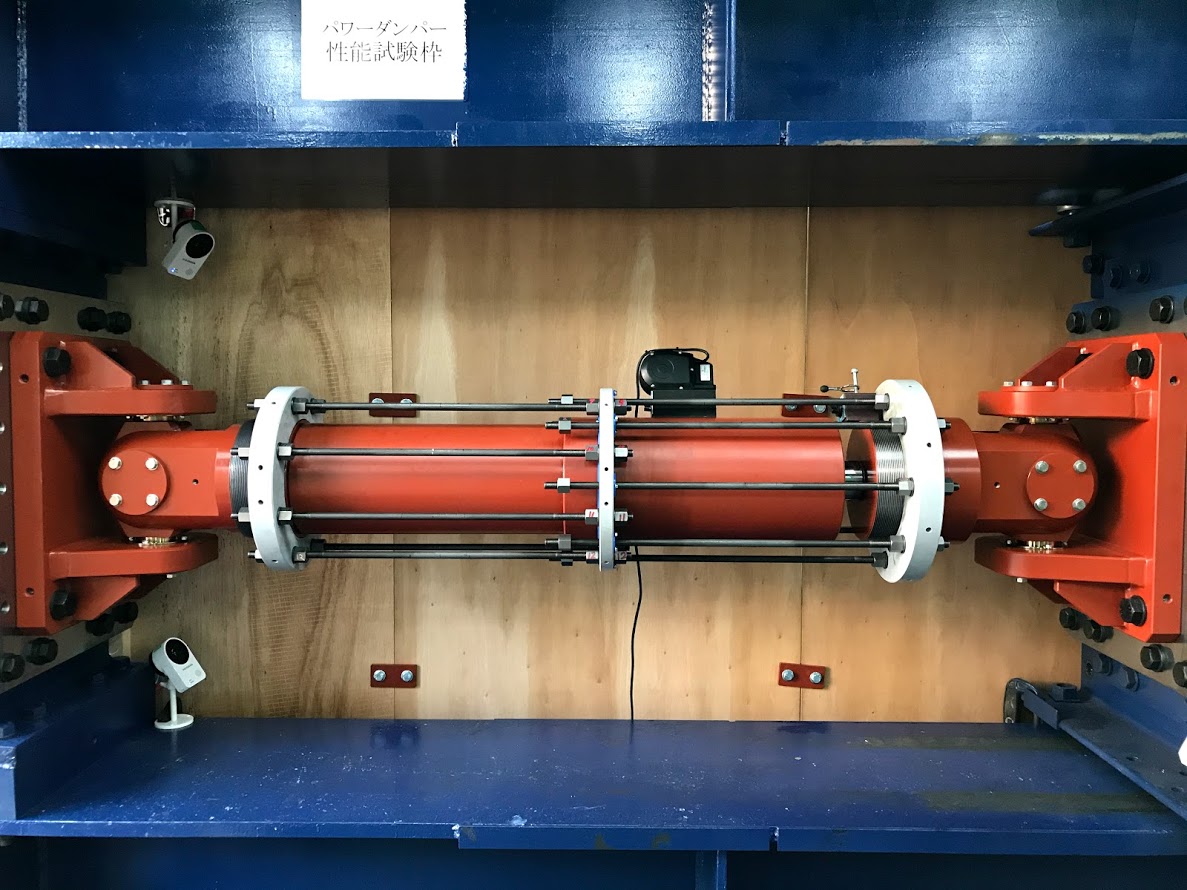
The Kire-Uriwari Bridge on the Matsubara Line of the Hanshin Expressway No. 14 was replaced with a steel 3-diameter continuous steel slab box-girder bridge from a PC 3-diameter continuous hinged ramen box-girder bridge (Dywidag bridge) in order to ensure long-term durability and improve maintenance management. During the construction, a section of the expressway was closed to traffic for two and a half years, and a construction method was adopted to minimize the impact on citizens' lives directly above a heavy traffic intersection in an urban area, and the PC box girder bridge was removed, and a new steel box girder bridge was erected.
6. Seismic Retrofitting Technology for BP Bearings
- Metropolitan Expressway Co., Ltd
- Shutoko Technology Center
- Nippon Chuzo K.K
Contributors of this project (Japanese)
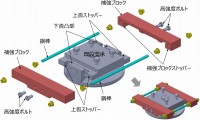
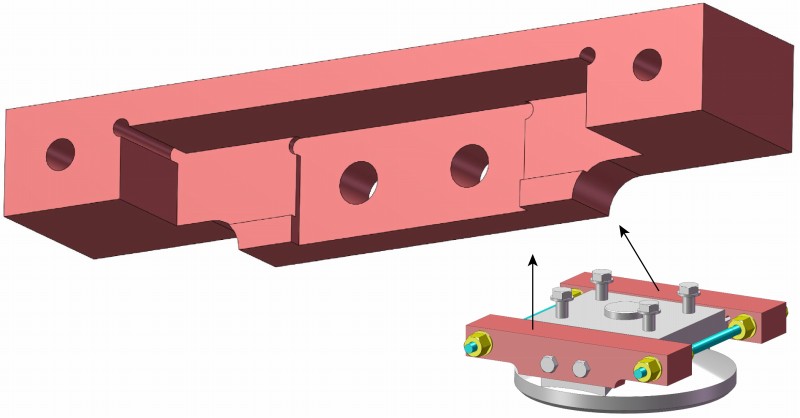
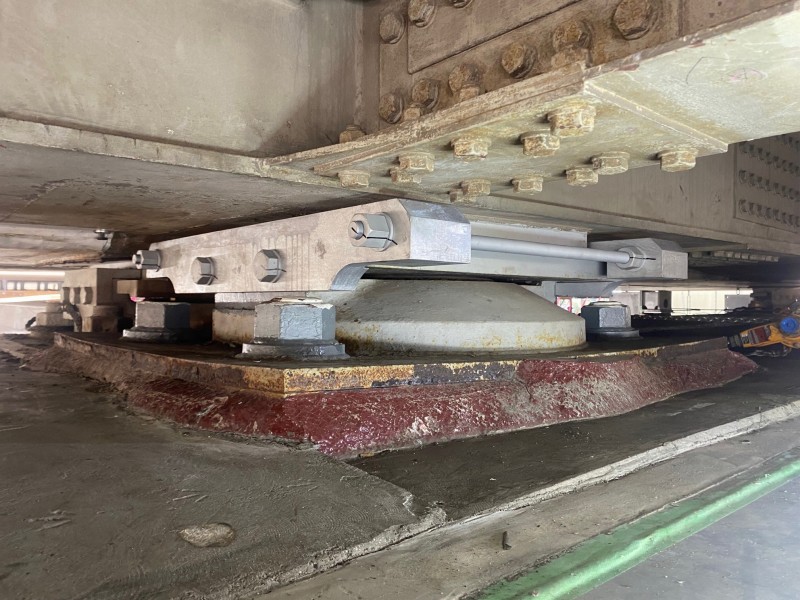
This technology is designed to improve the seismic performance of existing bearing plate (BP) bearings.
Newly developed reinforcement blocks are attached to both sides of an existing BP bearing with high-strength bolts and connected with steel rods. These reinforcement blocks work together to resist seismic forces during an earthquake, significantly improving the seismic performance of the bearings. Since installation is completed simply by attaching the reinforcement blocks, construction time and costs are greatly reduced.
This technology is expected to make a significant contribution to improving the seismic performance of BP bearings, which are widely used in bridges across the country.
7.Development of a backward-rotating, self-propelled dismantling machine of launching girders
- Yokogawa Bridge Corp.
Contributors of this project (Japanese)
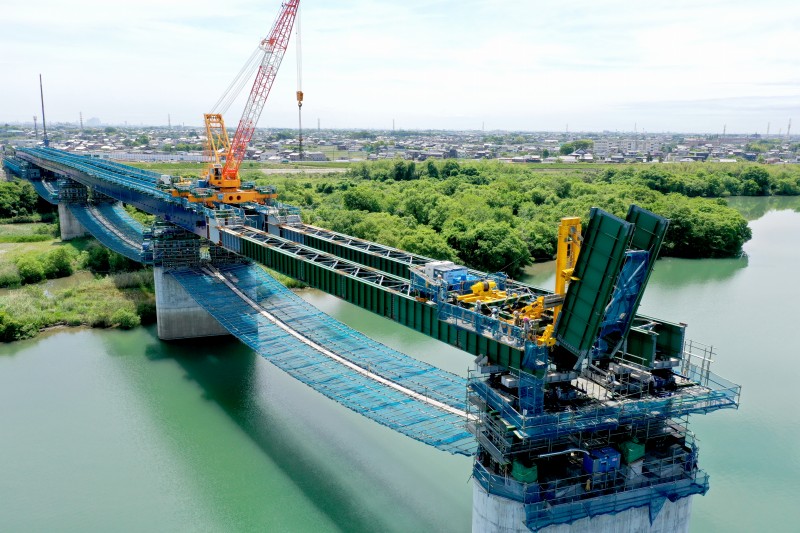
The backward-rotating, self-propelled dismantling machine for launching girders is a machine that doesn’t need any kind of heavy lifting crane, temporary stage, or barge for mounting the crane to dismantle the launching girders. Using the dismantling machine helps protect the environment by eliminating the need for cranes and temporary works on the river. In urban areas where yards for dismantling launching girders are too narrow or congested with buildings and/or houses for crane operation, the machine can be adopted. Since launching girders can be dismantled on bridge girders under construction, the machine is suitable for these confined areas.

